
MANAGE
your grid
Invest where it counts
Interventions in the low-voltage grid are mostly triggered by customer complaints. With data, problems can be detected before the complaints arrive, and interventions become more targeted and take less effort.
IN OPERATION
IN OPERATION
THE CHALLENGE
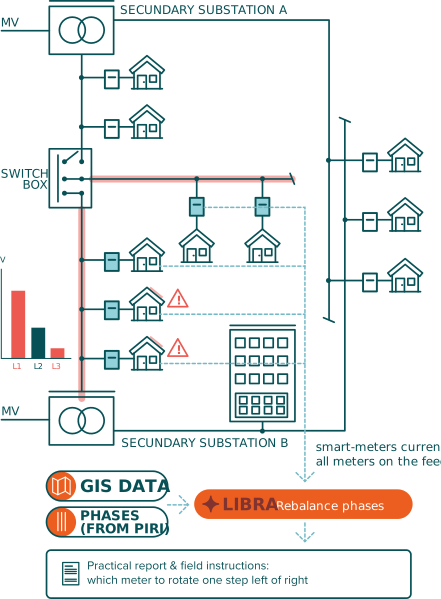
Low-voltage grids are resistive and unbalanced. Large phase unbalance results in inefficient asset capacity usage, since one phase hits its limit while the others stay underused. If the unbalance grows too large, it skews the voltage profile along the feeder, causing over- or under-voltages that trip solar inverters and other equipment into protective disconnection. Traditionally, detecting unbalance depends on customer reports and complaints, and the remedies, such as zero-sequence transformers, are labour-intensive and costly.
OUR SOLUTION
Libra is the next step after Piri. Once Piri has mapped the grid’s connectivity, including phase connectivity, feeders with high phase unbalance can be flagged. Libra then uses smart meter current measurements and GIS data to determine the phase swaps needed to restore balance with the fewest possible meter reconnection interventions. Co-developed with Fluvius after Piri identified that 3,3% of their feeders faced voltage unbalances exceeding 15 V, Libra solves this successfully, helped by strong acceptance among technicians. It is today fully operationally deployed.
The output of Libra is an easy-to-read instruction for field technicians:
- Data and figures that quantify the unbalance and illustrate the fix, so technicians can verify both the problem and the solution themselves.
- A list of the addresses where an intervention is required, with a simple instruction: rotate the phase connections at the meter one step left or one step right.
Libra rebalances a feeder with a quick, simple intervention at a limited number of meters. This saves time and is one to two orders of magnitude cheaper than traditional solutions.
IN OPERATION
THE CHALLENGE
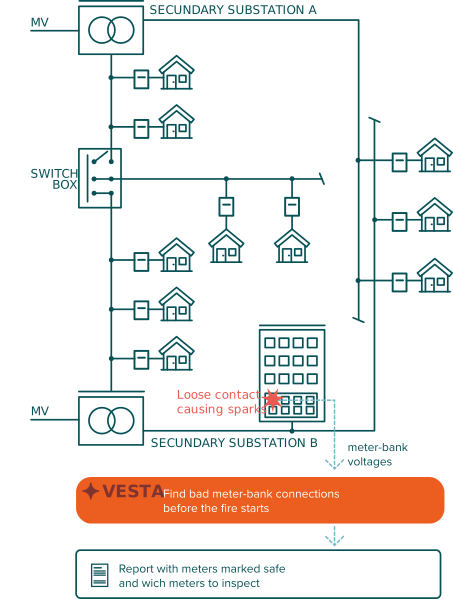
The screws that tighten wire connections in meter banks can loosen through vibration or heating-and-cooling cycles. This causes sparks that can, over time, turn into fires. Checking all these connections by hand is too labor-intensive.
OUR SOLUTION
Vesta uses smart meter voltage measurements from apartment meter banks to detect the signature voltage dips caused by sparks, even in 15-minute averaged values. Co-developed with Fluvius after several meter banks overheated and melted parts within a short span, Vesta found deviant voltage drops in 5% of the meter banks; in nearly all of those visited, loose contacts were found. It is today fully operationally deployed.
What Vesta does:
- Categorizes most meter banks as safe automatically; these require no manual action.
- Generates, when loose contacts are detected, an easy-to-read report for the technician, listing the specific meters and connections that require inspection. The report is self-contained, so technicians can validate for themselves that an intervention is justified.
IN OPERATION