

operate
your grid
From interventions to continuous control
Automated control of the low-voltage grid is the final step. These tools forecast the state of the low-voltage grid, deliver accurate grid data for TSOs and aggregators, and support decision-making on automated control actions, including activating low-voltage flexibility.
IN PILOT
IN PILOT
THE CHALLENGE
Historically, low-voltage grids were steady-state or only slowly evolving, and fit-and-forget was an effective way to manage them. This is changing fast, on one hand because of the steep growth of solar production, electric charging, and heating and cooling, and on the other because of increasingly controlled and therefore more synchronised behaviour, driven by time-of-use tariffs and by the use of LV flexibility for balancing. DSOs already struggle to keep up with reinforcements, and maintaining fit-and-forget under this higher synchronicity would put a great deal of precious metal in the ground. The alternative is to publish grid-capacity information and forecasts, and to use (technical) flexibility to safeguard the grid and buy time for reinforcements.
OUR SOLUTION
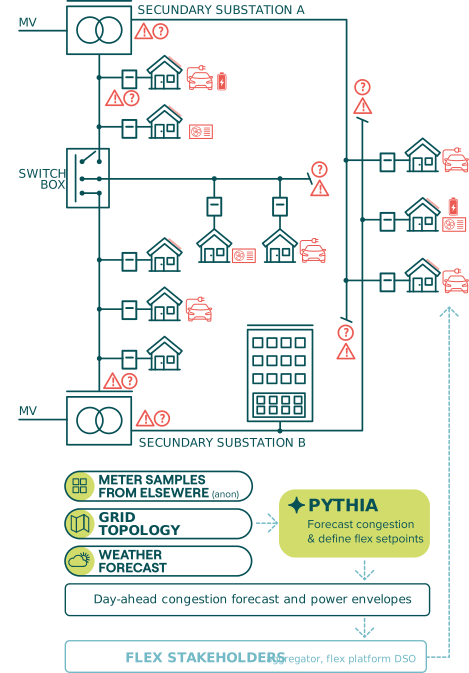
Pythia uses anonymised smart meter data and grid topology data to forecast congestion and calculate flexibility signals. Co-developed with Mitnetz Strom and Avacon using E.ON Lab data, it forecasts day-ahead feeder load and voltages using no local sensors at all — no feeder-head, transformer, nor on-site smart meter measurements. In an early German pilot, its feeder-head load forecasts came within about 1,2 kW of the measured load (CRPS), a small margin given typical feeder loads. Pythia is in pilot.
What Pythia does:
- Forecasts LV grid congestion:
- Calculates the congestion probability day-ahead, per quarter hour, for each bus in the LV grid.
- Builds on our unbalanced statistical power flow (see The Orion statistical power-flow engine).
- Requires no local feeder, transformer, or smart meter measurements; a representative set of anonymized smart meter measurements, taken anywhere in the grid, suffices.
- Delivers field-validated accuracy. Significant deltas between our forecasts and field measurements are used by our DSO customers as an indicator of grid-data-quality issues.
- Calculates power envelopes and other flexibility control signals:
- An optimiser determines which connections need to be constrained, and by how much, to reduce congestion risk to acceptable levels.
- Code structured so it can be adapted to your local regulation with little effort.